
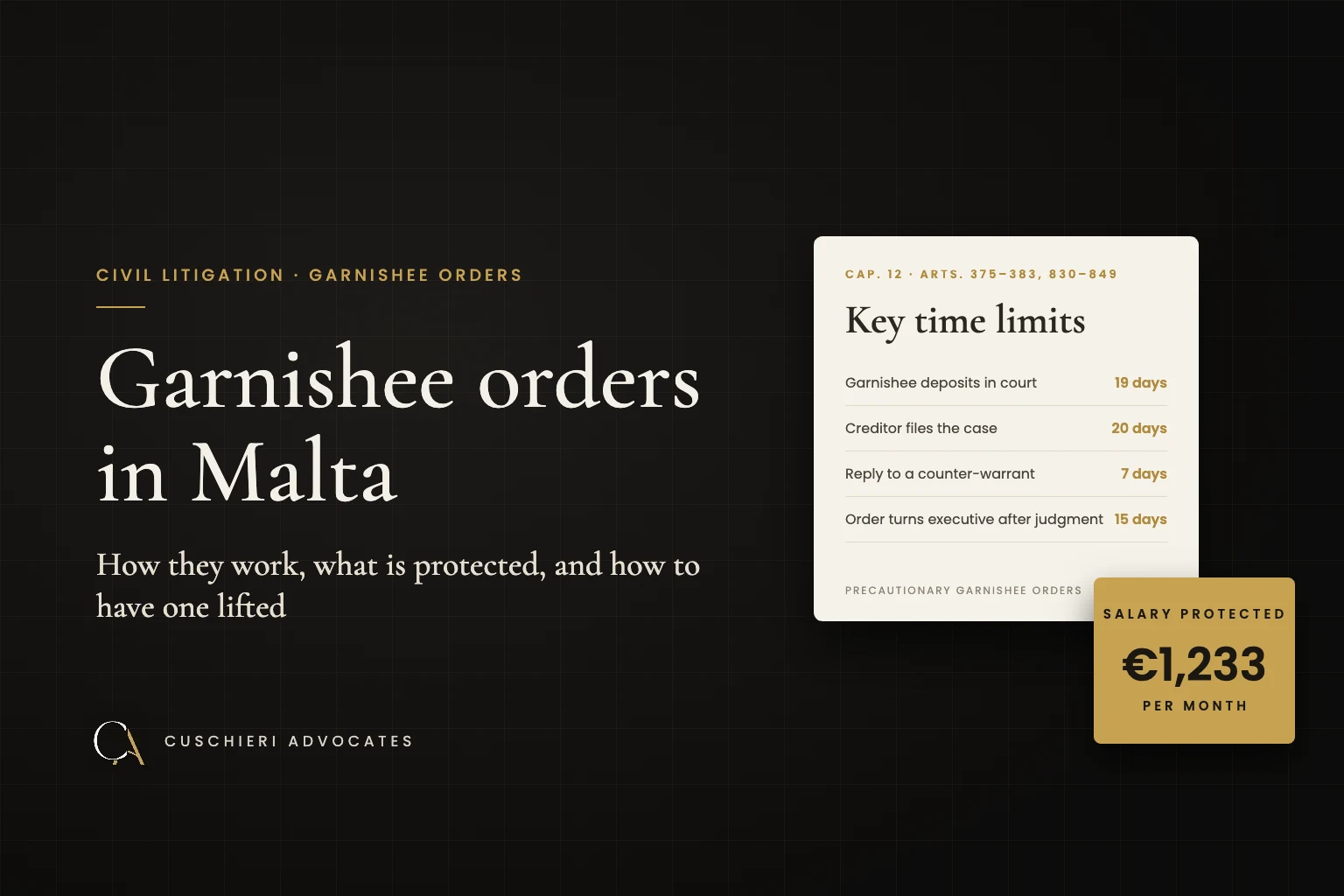
Garnishee orders in Malta: how they work and how to have one lifted
A garnishee order in Malta freezes money that a third party, most often a bank or an employer, holds for or owes to a debtor. Debtors often only find out when a card is declined or a salary arrives short. This article explains the two kinds of garnishee order, what the law protects from them, and the routes available to have one lifted. The rules are in the Code of Organization and Civil Procedure (Cap. 12).
What is a garnishee order?
A garnishee order (mandat ta’ sekwestru) is a court order served on a third party, the “garnishee”, who holds money or movable property belonging to the debtor. It orders the garnishee not to pay or hand over that money or property to the debtor or anyone else, and to deposit it in court through the Registrar. The garnishee has nineteen days from service to make the deposit, at the debtor’s expense (art. 376(2)).
The order must state the debtor’s name and identifying details (where possible an ID card or company registration number), the amount due and the title the creditor relies on. If any of these particulars is missing, the order is null by operation of law (art. 376(3)).
The order is served on the garnishee by a court executing officer, or electronically where this has been prescribed, and a copy must also be served on the debtor (art. 377). A garnishee that holds attached money but does not deposit it on time is liable to the creditor for damages and interest, and the court may order its personal arrest for up to three months to force the deposit (art. 378).
Executive and precautionary garnishee orders
Executive garnishee order
An executive garnishee order is available to a creditor who already holds a judgment or another executive title (art. 375). Executive titles are listed in article 253 and include judgments and decrees of the Maltese courts, notarial contracts for a debt that is certain, liquidated and due, registered arbitration awards, and bills of exchange and promissory notes under the Commercial Code.
Precautionary garnishee order
A precautionary garnishee order is issued before the creditor has a judgment, to secure a claim while the case is pending (art. 830(1)(d)). The creditor applies to court with a sworn application stating the origin and nature of the claim and the amount claimed (arts. 831 and 832). Under article 849, a precautionary garnishee order has the same effects as an executive one.
Because it is granted without the debtor being heard, the law balances it with strict conditions:
- the creditor must file the court case within twenty days of the order being issued. If it fails to do so without just cause, the order loses its effect and the creditor becomes liable for damages (art. 843, applied by art. 849). The debtor may agree to a longer period by note filed in the registry (art. 844);
- once the case is decided with a final judgment (res judicata), the precautionary order stays in force for fifteen days and becomes executive. Within fifteen days of obtaining the executive title, the creditor must file a note asking the court to extend or reduce its effects to the amount of the judgment, interest and costs (art. 838B).
A precautionary garnishee order cannot be issued against the Government of Malta (art. 837(2)) or to secure a claim for damages for defamation (art. 837(6)).
What a garnishee order cannot touch
Article 381(1) lists property that cannot be attached. The main categories are:
- salary and wages, including bonus, allowances and overtime, up to the protected amount explained below;
- social security benefits and pensions, including private pensions and pensions from foreign governments. For private and foreign pensions, the protection is capped at the amount of the highest pension paid by the Government;
- charitable grants or donations made by the Government;
- maintenance awarded by the court or by public deed, and bequests made expressly for maintenance where the debtor has no other means of subsistence, unless the debt being enforced is itself a maintenance debt;
- loans made available to the debtor to build or maintain their main home;
- overdraft facilities used to operate a business (credit cards are not covered);
- bank guarantees and letters of credit;
- benefits or subsidies from the Housing Authority;
- bank accounts used solely to receive benefits, pensions, government grants or Housing Authority payments. Banks named as garnishees must make sure these accounts are not affected, and banks are obliged to open and maintain such accounts (art. 381(1)(j)).
There is also a protection for employees. If the debtor is an employer, a garnishee order against the employer cannot attach the salaries and wages of its employees, provided the garnishee is formally told about this (art. 381(4)).
How much of a salary is protected?
Article 382 allows a garnishee order to attach only the part of a salary or wage that exceeds the protected amount. Since 1 January 2024, that amount is €1,233 per month, set by the Salary or Wage (Exemption from Attachment) Order, 2023 (L.N. 302 of 2023).
If the debtor needs part of the excess to maintain themselves or their family, they can apply to court. If the court is satisfied, it will revoke the order for that part. Either side can later ask the court to change its decision if the debtor’s circumstances change materially (art. 382(2)).
How to have a garnishee order lifted
There are several routes, depending on the kind of order and the reason it should not stand.
1. Deposit or security
A precautionary act, including a precautionary garnishee order, must be rescinded if the debtor deposits money or gives security that the court considers sufficient to safeguard the creditor’s claim (art. 830(2)(a)). This is often the quickest way to free a frozen bank account when the claim itself is disputed. The creditor still has to file its case within the time limits (art. 830(2)(b)).
2. A counter-warrant under article 836
The debtor can apply to the court that issued the precautionary act, or to the court hearing the case, to revoke it in whole or in part (art. 836(1)). The grounds are that:
- the precautionary act has ceased to be in force, for example because the case was not filed in time;
- a condition the law requires for issuing it does not in fact exist;
- other adequate security is available to the creditor;
- the amount claimed is not justified at first sight (prima facie) or is excessive;
- the security provided is sufficient; or
- in the circumstances, keeping the order in force would be unreasonable, or it is no longer necessary or justifiable.
The application must be filed with all the submissions and supporting documents. The creditor has seven days from service to reply, and the court decides with urgency, with no more than one sitting (art. 836(2)–(4)). A decree that grants the counter-warrant cannot be appealed (art. 836(5)).
3. Exempt money caught by mistake
If a bank has frozen pension or benefit payments that article 381 protects, contact the bank first: it must keep those accounts free of the order. If that fails, apply to court; for salaries, article 382 applies.
4. Payment or settlement
Paying the debt, or agreeing a settlement and having the creditor withdraw the order, ends it. An executive garnishee order cannot be extended and remains in force until a court decree revokes it (art. 383), so the withdrawal should be confirmed in the court record.
Penalties for abusive orders
The court can order a creditor who obtained a precautionary act to pay the debtor a penalty of between €1,164.69 and €6,988.12 (art. 836(8)) where:
- the creditor fails without a valid reason to file the case in time;
- the creditor cannot show that the order was needed, or that within the fifteen days before applying it asked the debtor to pay or to give security (unless there was urgency);
- the debtor’s solvency was notorious and beyond reasonable doubt; or
- the claim was malicious, frivolous or vexatious.
The debtor may also claim damages caused by the order (art. 836(9)). On good cause, the court may order the creditor to give security for any penalty and damages, and rescind the order if the creditor does not (art. 838A).
Frequently asked questions
Can a garnishee order take my whole salary?
No. The first €1,233 a month is protected, and only the excess can be attached. You can also ask the court to release part of the excess if you need it for your own or your family’s maintenance.
Can my pension or social security benefit be frozen?
Social security benefits and pensions cannot be attached. Private and foreign pensions are protected up to the amount of the highest Government pension. Bank accounts used only to receive these payments must also be left free.
How long does a precautionary garnishee order last?
The creditor must file its case within twenty days, or the order lapses. If the case is filed, the order stays in force until it is revoked or until fifteen days after final judgment, when it becomes executive.
Cuschieri Advocates assists both creditors and debtors with garnishee orders and counter-warrants before the Maltese courts. See our Civil Litigation page. For businesses facing wider financial difficulty, see also our article on insolvency versus liquidation in Malta.
This article is general information only and is not legal advice. It reflects the law as at November 2026.